Thermal shock is one of the leading causes of refractory failure. Discover how kaolin clay helps improve thermal stability, supports mullite formation, and reduces cracking and spalling in demanding high-temperature applications.
In refractory applications, high temperature alone is not the only challenge. The real test begins when temperatures change rapidly.
Sudden heating or cooling creates uneven expansion within the refractory body. This generates internal stress, which can lead to cracking, spalling, reduced lining life, and avoidable downtime. That is why thermal shock resistance is a critical property in any refractory system expected to perform reliably under industrial conditions.
At PatelNagar Refractories Pvt. Ltd. (PRPL), we view kaolin clay as more than a conventional mineral input. It is a technically significant refractory raw material that helps support structural stability, thermal resilience, and dependable high-temperature performance.
What Is Thermal Shock in Refractories?
Thermal shock occurs when a refractory is exposed to rapid heating or cooling, causing one part of the material to expand or contract faster than another. This mismatch creates stress within the refractory body.
If that stress exceeds the strength of the material, damage begins to develop. In industrial use, that damage often appears as:
- cracking
- spalling
- edge failure
- loss of structural integrity
- shortened service life.
Thermal shock is therefore not just a materials science concept. It is a practical operating challenge that directly affects refractory durability and plant efficiency.
Thermal shock is not merely exposure to heat. It is damage caused by stress from uneven temperature change.
Why Thermal Shock Is a Serious Industrial Concern
In high-temperature operations, thermal shock can arise during:
- furnace start-up
- shutdown cycles
- sudden process fluctuation
- inconsistent heating curves
- localised flame exposure
Even a refractory with strong heat resistance can fail if it lacks the ability to manage thermal stress effectively.
Industrial consequences include:
- more frequent maintenance
- increased refractory replacement.
- production interruption
- lower operating efficiency
- higher long-term cost
This is why refractory reliability depends not only on refractoriness, but also on the stability of the mineral system used to build the lining.
Why Kaolin Clay Matters
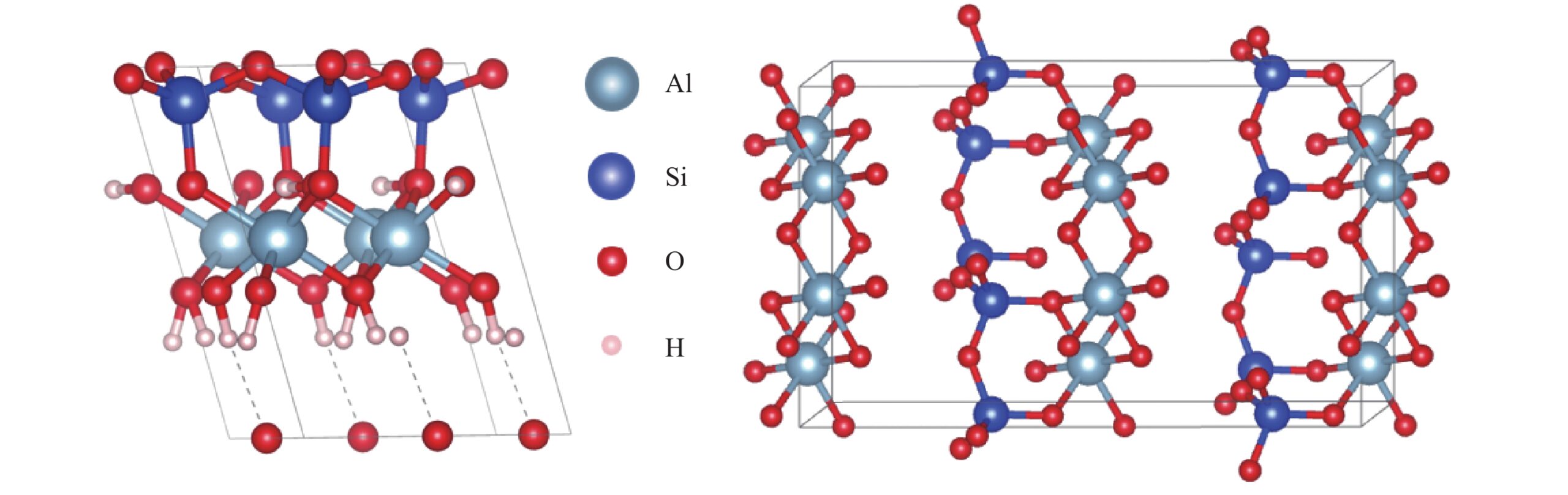
Kaolin clay is a valuable aluminosilicate mineral used in refractory systems because it helps support the development of a more stable ceramic structure.
Its significance lies in its transformation during controlled thermal processing. When properly calcined and incorporated into refractory-grade systems, kaolin contributes to improved stability under high-temperature and thermal cycling conditions.
In simple terms, kaolin clay helps refractories perform better when heat changes rapidly.
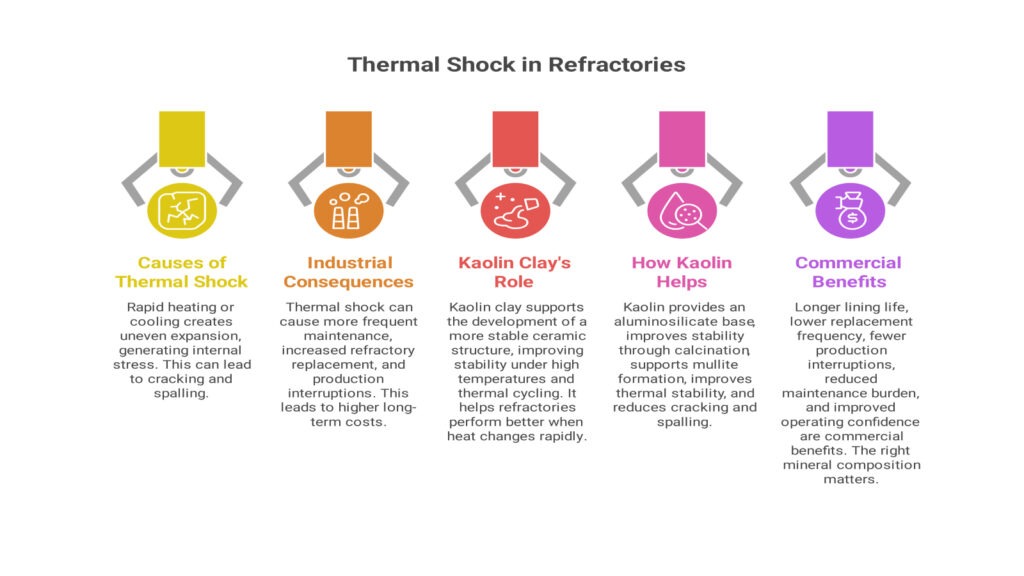
Thermal Shock in Refractories – Kaolin Clay’s Role
A concise overview of the causes of thermal shock, industrial consequences, how kaolin helps improve refractory performance, and the resulting commercial benefits.
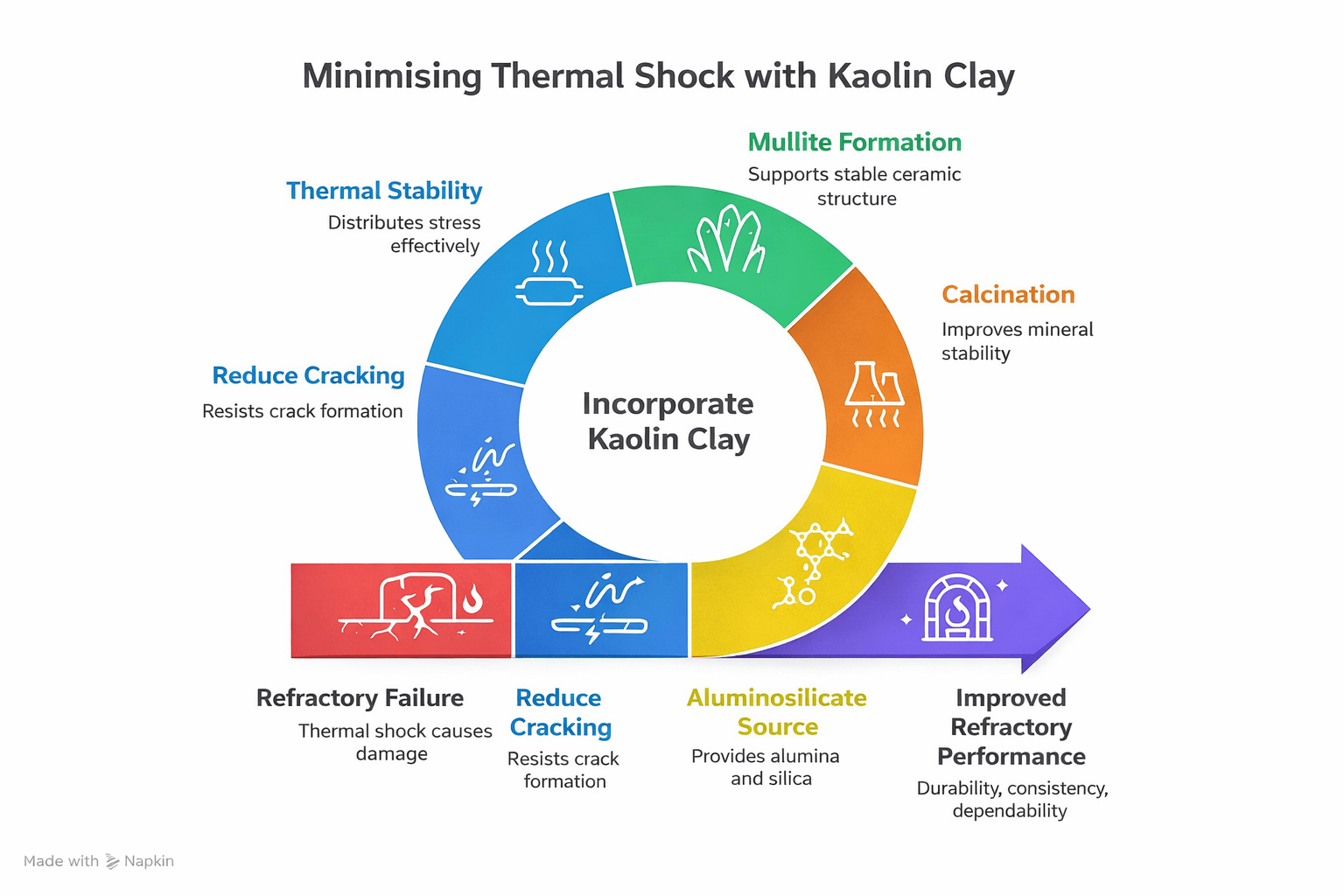
How Kaolin Clay Helps Minimize Thermal Shock
1. It provides an important aluminosilicate base
Kaolin clay serves as a useful source of alumina and silica, both of which are important in refractory phase development.
2. Calcination improves its stability
When kaolin is calcined under controlled conditions, chemically combined water is removed and the mineral enters a more stable state for refractory application.
3. It supports mullite formation
One of the most important benefits of kaolin is its contribution to mullite-rich phase development. Mullite is highly valued for its thermal stability, structural strength, and resistance to thermal stress.
It improves thermal stability
A more stable mineral structure helps the refractory body withstand repeated heating and cooling with lower internal stress concentration.
It reduces cracking and spalling
By contributing to a stronger and more coherent refractory matrix, kaolin helps lower crack initiation and restrict crack propagation, thereby reducing spalling risk.
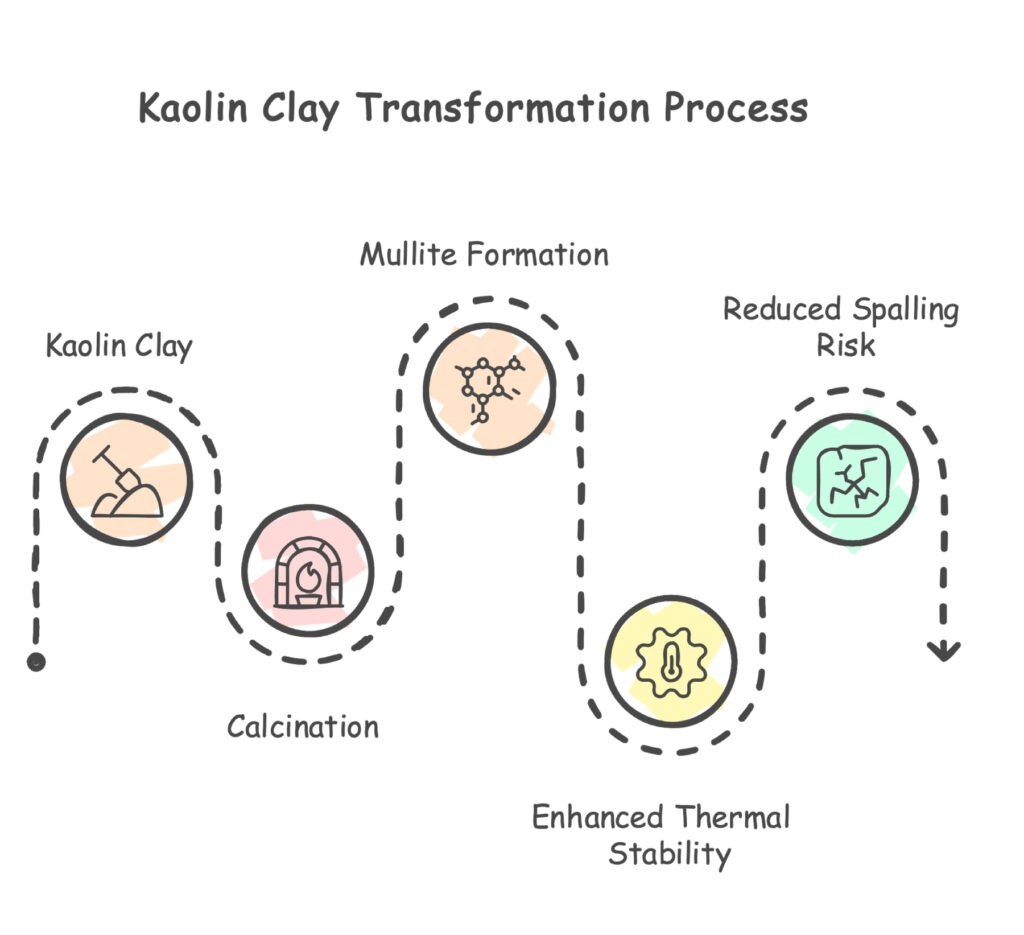
This sequence explains why kaolin clay remains highly relevant in refractory-grade mineral systems. It is not simply a raw material. It is part of the performance chain that improves refractory endurance under thermal shock conditions.
Why This Matters Commercially
In industrial refractory use, material failure is never only a technical issue. It has direct operational and commercial consequences.
Better thermal shock resistance can lead to:
- longer lining life
- lower replacement frequency
- fewer production interruptions
- reduced maintenance burden
- improved operating confidence.
That is why the right mineral composition matters. Kaolin clay contributes not only to refractory chemistry, but to refractory reliability.
Kaolin-supported mullite formation helps create a more stable refractory structure with lower susceptibility to thermal shock damage.
PRPL’s Perspective
At PatelNagar Refractories Pvt. Ltd. (PRPL), we understand that reliable refractory performance begins with disciplined mineral processing and consistency of thermal transformation.
For applications where performance under heat cannot be compromised, kaolin clay remains a strategically important refractory mineral. Its contribution to thermal stability, mullite development, and structural integrity makes it highly relevant in demanding operating environments.
At PRPL, we believe that better refractory performance begins with better mineral engineering.
Conclusion
Thermal shock is one of the most common causes of refractory damage. Rapid temperature change generates internal stress, which can lead to cracking, spalling, and premature lining failure.
Kaolin clay helps minimise this risk by supporting calcination-driven mineral stability, mullite-rich phase development, improved thermal performance, and lower crack propagation.
In refractory applications, kaolin clay is not just a mineral input. It is a performance mineral that supports durability where it matters most.
Refractory reliability begins with the right mineral foundation.
Looking for refractory-grade mineral solutions designed for dependable high-temperature performance? Connect with PRPL to learn more about our mineral-focused approach to refractory reliability.